







NanoGlass™
Technologies
Transform your poorly soluble molecules into clinically viable formulations using our proprietary NanoGlass™ Technologies
What Is NanoGlass™ Technologies?
At the heart of the NanoGlass™ formulation technology approach lies a simple but powerful principle:
to maximize oral bioavailability, the most effective strategy is to generate amorphous nanoparticles of the active pharmaceutical ingredient (API).
These particles create the highest possible thermodynamic activity, in other words, the greatest driving force for the API to cross biological barriers and be absorbed into the bloodstream.
To enable this, we’ve developed four proprietary formulation platforms:
- Two solid-based
- Two liquid-based
Each is designed to suit different molecule classes and development objectives.
NanoGlass™ is the unifying framework that powers these technologies, enabling stable, high-performance formulations tailored to the physicochemical properties of the API.
technology Users


Our NanoGlass™ technology is divided into the following four platforms:
GlassE™
Instant Release Glass
A polymer free solid formulation with instant release to generate amorphous nanoparticles in the stomach. With high drug loading, chemical stability and rapid API release.
GlassA™
Controlled Release Glass
A solid formulation enabling high drug loading, controlled API release, and improved chemical stability, giving a tablet final dosage form.
HyGlass™
Hydrophilic Liquid
High drug load hydrophilic liquid formulation with simplified manufacturing and a capsule final dosage form.
LiGlass™
Lipophilic Liquid
The same high oral bioavailability as traditional lipid formulations with a 10x higher drug loading with a capsule final dosage form.
How NanoGlass™ Technologies Enhance Oral Bioavailability
The NanoGlass™ formulation is taken orally, either as a tablet or capsule. In the gastric environment, the formulation dissolves and releases the active ingredient.
Amorphous nanoparticles form in the gastric fluid and maintain the drug in a supersaturated state. These nanoparticles remain stable through the GI tract and replenish the solublized fraction following absorption in the small intestine. The drug is absorbed across the intestinal membrane, driven by high thermodynamic activity.
Benefits of the NanoGlass™ Approach
Enhanced Solubility, Dissolution, and Bioavailability
Improves drug solubility and absorption by generating stable amorphous nanoparticles.
Consistent Nanoparticle Formation and Optimized Release
Ensures uniform particle generation and controlled release across physiological conditions.
Higher Drug Loading with Stable Formulations
Achieves high API concentrations while maintaining physical and chemical stability.
Scalable and Manufacturing-Friendly Process
Enables robust production from early development to commercial scale.
Flexibility Across Dosage Forms
Adaptable to capsules, tablets, and other oral delivery formats.
Approved Excipients
Use of safe, GRA-certified and FDA approved excipients ensuring regulatory alignment
NanoGlass™ For Small Molecules
Proven Success with Challenging Small Molecules
Explore examples of how we’ve successfully formulated difficult small molecules using our NanoGlass™ technologies. You can download the full case studies below for more detail on each project
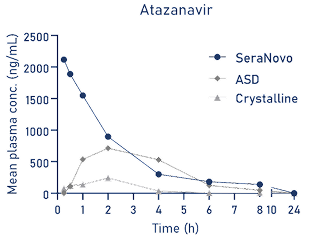
Case study HyGlass™ Platform
STUDY DESIGN
Dose: 15 mg/kg
Administration route: Oral
- 75% increase in bioavailability
- Simplified manufacturing
- Physically stable final form
- Well-suited for both preclinical and clinical development
➔ Ideal for compounds that are weakly basic and a high melting point
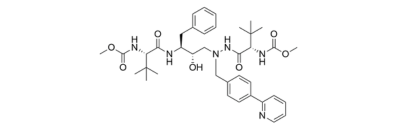
Molecule Name: Atazanavir
Molecular weight: 704.9 g/mol
BCS: Class II
Water solubility: 3.27 μg/mL
Animal Model: Male rats, n=6
Nutritional state: Fasted
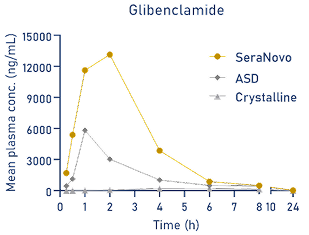
Case study LiGlass™ Platform
STUDY DESIGN
Dose: 15 mg/kg
Administration route: Oral
- 2.75x higher bioavailability
- Simplified manufacturing
- Physically stable final form
- Well-suited for both preclinical and clinical development
Molecule Name: Glibenclamide
Molecular weight: 494 g/mol
BCS: Class II
Water solubility: 2.06 μg/mL
Animal Model: Male rats, n=6
Nutritional state: Fasted
Case study GlassE™ Platform
STUDY DESIGN
Dose: 10 mg/kg
Administration route: Oral
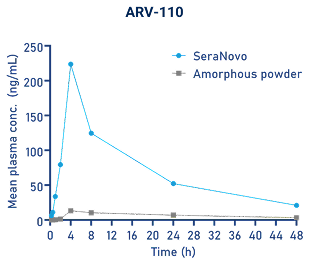
- 5.6× increase in bioavailability compared to reference
- Stable final formulation with no crystallization or phase separation
- Simplified manufacturing suited for scale-up
- Supports rapid progression from preclinical to clinical development
➔ Ideal for compounds that are weakly basic and a high melting point
Molecule Name: ARV-110
Molecular weight: 812.3 g/mol
BCS: Class IV
Water solubility: 1.2 μg/mL
Animal Model: Male rats, n=4
Nutritional state: Fasted
NanoGlass™ For Protein Degrader
Protein degraders present a unique challenge for oral delivery due to their size, flexibility, low solubility, and limited permeability. At SeraNovo, we develop formulations that address these issues directly, enabling oral absorption of compounds that typically fall far outside traditional drug-like space. Our technologies are designed to form amorphous nanoparticles in the gastrointestinal tract, creating the concentration gradient needed to support efficient uptake.
5.6× Increase in Bioavailability
NanoGlass™ formulations enabled a significant improvement in the oral bioavailability of ARV-110. The full case study is available for download below.
NanoGlass™ For Peptides
We are actively applying our NanoGlass™ technology to peptides, improving their absorption and unlock new possibilities for oral delivery. You can read more about our approach and early findings in our articles and blog posts.